Academics
My mentor was a crusty old surgeon. Difficult, uncompromising, and a deep well of wisdom. When I first started out 25 years ago, he taught me that a surgeon’s career unfolds in three stages. The first is struggle. These are the early years of learning how to be a surgeon, learning how to avoid mistakes, how to build trust, and how to care for patients. It is a time of growth, uncertainty, exhaustion and hardship.
The second stage is success. These are the years when confidence grows, when your skill matches your ambition, when you are finally able to meet the needs of patients in the way you trained so long to do. If you are so fortunate, these are also the years when your family grows, when you nurture children and watch them thrive.
The third stage, my mentor told me, is succession. This is the moment when you hand off to the next generation, as my mentors once handed off to me. At some point, you are called to leave the comforts of success to take on this next great challenge. For many years, I thought of succession as a call to adventure, the moment of departure into the unknown task of handing over everything you have built.
But as I have reflected more deeply, I have come to believe there is another stage, one that rests between success and succession. That stage is Salt.
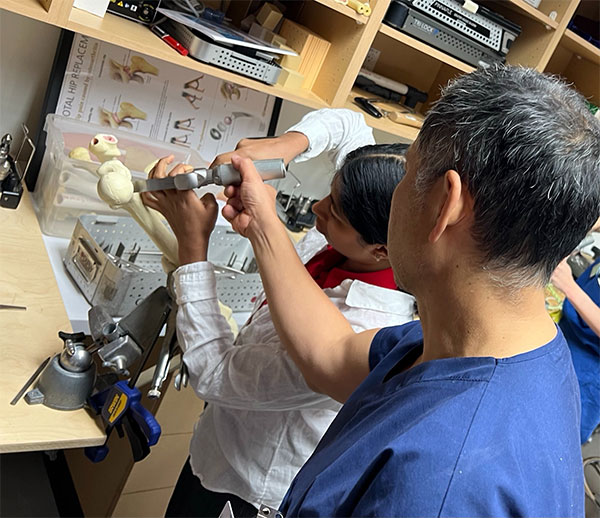
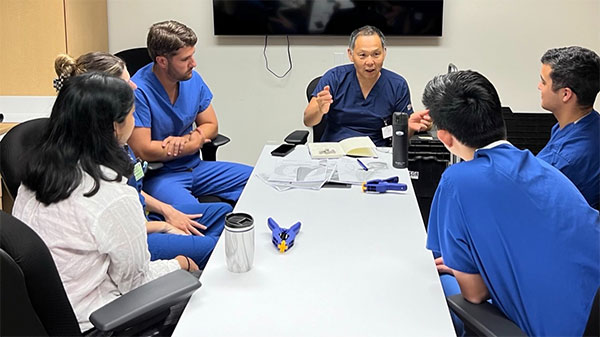
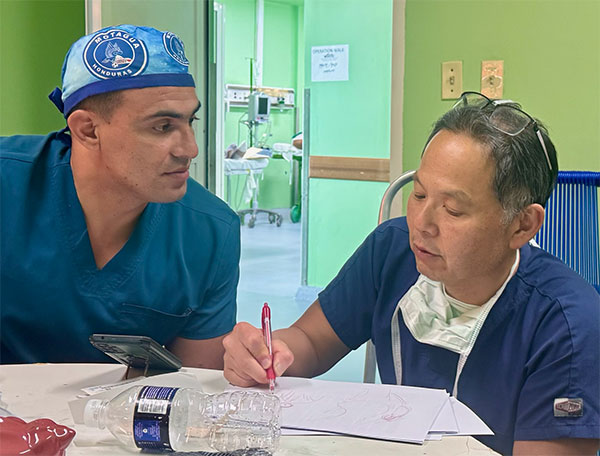
Salt brings richness, depth, and complexity. It preserves what is good, sharpens what is dull, and awakens what is bland. At USC, there are students, residents, and trainees whose lives are to be made richer, fuller, and more profound by the presence of someone who can draw out what is latent in them.
And I would add, in that same season, we are called also to be Light. Light is warmth, encouragement, and revealed truth. It illuminates the path on which a young student walks so he can see the direction forward.
I now appreciate this fourth sacred interval as the stage of Salt and Light. It is in this stage that the teacher takes up the unique responsibility of adding richness and warmth to the lives of trainees, so that they, in turn, may meet the struggles ahead with clarity and depth.
- Minimally Invasive Total Knee Replacement
- Minimally Invasive Total Hip Replacement
- Partial Knee Replacement
- Arthritis
- Mako Robotic-Arm Assisted Technology for partial knee replacement
- Mako Robotic-Arm Assisted Technology
- Dr. Yun Explains The MAKO Robotic Assisted Partial Knee Replacement
Recent Articles
- Conversion Total Hip Arthroplasty with a Direct Anterior Approach for Failed Treatment of Acetabular Fractures
- Aseptic Loosening of Smaller Corail Stems in Heavy, Active Males: A Report of Three Cases
- Management of failed UKA to TKA: conventional versus robotic-assisted conversion technique
- Salvage of Failed Femoral Neck Fracture Fixation with Conversion Total Hip Arthroplasty Using the Direct Anterior Approach
- Modified Two-Stage Exchange for Periprosthetic Joint Infection in UKA
- Direct Anterior Total Hip Arthroplasty with Fluoroscopy to Mitigate the Risk of Complications in Patients with Legg–Calve–Perthes Disease
- Managing Protrusio Acetabuli With a Direct Anterior Approach Total Hip Replacement
- Understanding the risks of total hip arthroplasty in patients with von Willebrand’s disease
- Understanding the risks of total hip arthroplasty in patients with von Willebrand’s disease
- Management of failed UKA to TKA: conventional versus robotic-assisted conversion technique
- Salvage of Failed Femoral Neck Fracture Fixation with Conversion Total Hip Arthroplasty Using the Direct Anterior Approach
- Modified Two-Stage Exchange for Periprosthetic Joint Infection in UKA
- Conversion Total Hip Arthroplasty with a Direct Anterior Approach for Failed Treatment of Acetabular Fractures